
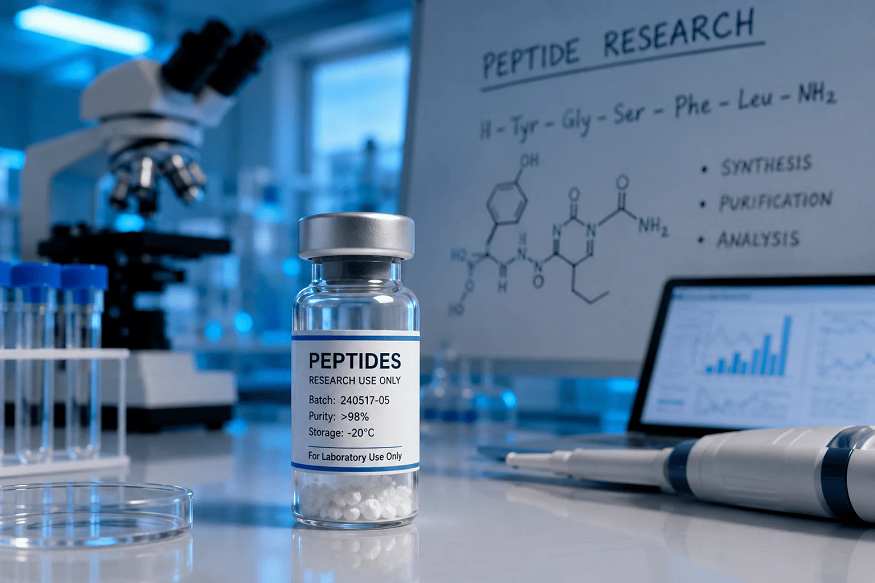
Identifying the structure and composition of a peptide is useful. Particularly when planning lab work. Characterization techniques provide alternative methods for analyzing a sample and verifying its content.
Several techniques can be employed simultaneously to provide a more comprehensive picture of the peptide’s:
- Identity
- Purity
- Structure
- Stability.
Let’s look at these methods:
High-performance liquid chromatography
This approach is widely used to separate the components of a peptide sample. The resulting chromatogram may display the major peptide peak as well as other peptides that were identified.
This means HPLC can be applied to demonstrate the relative purity and to detect possible related substances. Chromatographic techniques can also be used in peptide science to track the changes in a material over time or under varying storage conditions.
However, HPLC purity percentage does not provide all the information needed to prove the molecular identity. Therefore, it is often used alongside other techniques.
Mass spectrometry
Chemical mass spectrometrymeasures the mass-to-charge ratio of an ion. It gives valuable information about the material’s molecular mass. This helps determine whether the measured mass matches the compound’s mass.
Researchers can further extend the analysis by using tandem mass spectrometry. It fragments peptide ions into smaller molecules. The resulting patterns can then be used to explore sequence information. Hence, reveal some modifications.
Amino acid analysis
Peptides can be broken down. This analysis technique helps determine the types and quantities of amino acids present.This can be helpful for compositional information and can aid quantitative analysis.
It does not, on its own, provide all the information about the order of the amino acids in the original peptide. It can therefore be used in conjunction with other methods to provide sequence information when required.
Nuclear Magnetic Resonance
NMRspectroscopy can give information about the structure and activity of molecules in solution.It can reveal structural characteristics and interactions that a purity test may not fully capture.
Read More: Vertigo Treatment in Pimpri Chinchwad: Causes, Diagnosis & Treatment Options
Capillary Electrophoresis
With this approach, molecules separate as they move through a narrow capillary under an electric field. Various CE techniques are available for peptide analysis, such as those related to:
- Purity
- Quantification
- Sequencing
- Modification by chemical or enzymatic reactions.
This can help the researcher to analyze a sample again if the information from the chromatography or other analyses is insufficient.
Multiple methods can be useful
The techniques bring out different aspects.
- Components can be separated using HPLC.
- Molecular-mass and sequence data can be obtained from mass spectrometry.
- NMR can give structural data.
- Amino acid analysis and electrophoresis can provide further data.
Using complementary methods can be particularly useful when researchers need to investigate modifications or degradation.
However, in some cases, research has demonstrated that routine analysis is not sufficient to distinguish some peptide changes. More specific mass spectrometry analyses can prove beneficial.
Read More: The Hair Growth Answer That Isn’t Sitting on Your Bathroom Shelf
Final thoughts
Peptide characterization isn’t restricted to the analysis of just one purity parameter. HPLC, MS, NMR, amino acid analysis, and capillary chromatography can be used to examine various components of a sample. The best choice will depend on the research question and the information required about the material.
You may also like
-
Why Different Peptides Work Completely Differently
-
Home Health Agencies in Corpus Christi: Uncovering Their Impact
-
Recognizing the Hidden Signs of Low Blood Sugar While You Sleep
-
Healthcare Outsourcing to the Philippines: Achieving Revenue Cycle Excellence Through Strategic Partnership
-
The Quiet Standards That Define a High-Performing Endovascular Device Supplier in Modern Healthcare
1 thought on “PEPTIDE CHARACTERIZATION TECHNIQUES THAT MAY BE USEFUL FOR RESEARCHERS”